Showing posts with label Islam. Show all posts

Saturday, 4 August 2012

A Self-Fulfilling Prophecy

The US Commission on International Religious Freedom recently designated China a “country of particular concern” due to “systematic, ongoing, and egregious violations of religious freedom”. Amnesty International  has also been warning for some time that the human rights situation in Xinjiang has grown worse since July 2009. This week saw Andrea Evans at Foreign Policy bring the world’s attention to the arrests of more “religious extremists” in Xinjiang and severe restrictions on fasting for Ramadan. The growth of religious repression in Xinjiang has been fairly evident to those paying attention. Official signs restricting prayersand beards in hospitals is guaranteed to incite “the Uyghur people to resist even further”, in the words of Dilxat Raxit, spokesman for the World Uyghur Congress.

International media should be applauded for providing the world with a reasonably good coverage of the events of the last week. Al Jazeera quoted the Zonglang township government in Kashgar district, stating that it is “forbidden for Communist Party cadres, civil officials (including those who are retired) and students to participate in Ramadan activities” and that leaders should provide “gifts” of food to ensure they do not fast! The Financial Times astutely brought readers’ attention to the fact that fasting for Hui Muslims in other parts of China is permitted. This helps us see the inflation of the idea of “illegal religious activities” in Xinjiang where repression of Islam is justified as a response to “terrorism”. The only thing missing from this coverage has been to tell the world that these restrictions are nothing new. For some time, it has been de facto illegal for any public servant or anyone under 18 in Xinjiang to visit the mosque or participate in any religious activities. What may be new is that local government are explicitly explaining this on their websites, which suggests increasing confidence that religious practice can be directed by the state.

The BBC and the Guardian ran with the story of the conviction of 20 Uyghurs on terrorist charges. Both quote the World Uyghur Congress, while the Guardian at least points to the restrictions on religious clothing and beards emerging across Xinjiang. However, more cynicism is needed as the world’s media seem unwilling to point to the elephant in the room, which is that these are secret trials in a region with no clear evidence of rule of law. Official explanation of convictions remains typically unusual. The Washington Post and AFP point out these crimes were related to the use of “moveable hard drives” and “mobile phones” to “urge crimes of separatism, religious extremism, and terrorism”. Dilxat, quoted again, claims that China is handing out heavy sentences to Uyghurs “who use the internet to access information that is not controlled by the authorities and who are expressing opposing political views”. We would need more information from official channels to refute these claims as “removable hard drives” are not particularly terrifying.

Chinese officials then used the Global Times to say that “Xinjiang denies suppressing Islam”. This begins with an attack on US “double-standard” to assess China’s “efforts in fighting terrorism”, which offers nothing to address the concerns of Uyghurs. The article then commented on the blatant restrictions on observing Ramadan by quoting a random primary schoolteacher. The teacher claims parents all gave consent for their children to avoid fasting. She then went on to say that crime is committed under the banner of “religious freedom” and that it was important to make sure children aren’t misled by terrorists during Ramadan. Perhaps if officials said things about Islam that weren’t related to terrorism, Uyghurs may feel more secure. The World Uyghur Congress released a statement lamenting that the government ignores the “long-standing history and contribution” of Islam to China and that the authorities “opt to repress all aspects of Uyghur religious heritage, culture, and language, propagating ethnic tensions that need not exist”. Repression is making Uyghurs feel less secure and this will only exacerbate tensions and provoke violence if they have no legitimate means to express themselves. We fully recommend the following article by Sean Roberts of the George Washington University, which argues terrorism in Xinjiang is a “self-fulfilling prophecy” waiting to happen with the growth of repression.

Sunday, 1 July 2012

Shaping International Opinion: Holy War or a Dispute over a Seat?


This last week saw a return of many of the usual themes of official public discourse on Xinjiang. This is of course in the lead up to the third anniversary of the violence of July 2009, which saw Uyghurs and Han killing each other in Ürümchi. The authorities blamed an international terrorist plot for the violence committed by Uyghurs and chose not to acknowledge the violence committed against Uyghurs. So this week, China Daily ran with the very brief story of Guo Boxiong, vice chair of the Central Military Commission, announcing that the military and paramilitary forces will maintain stability and stressed the need for a “high level of ideological,political, and action unity”. Meanwhile, two Uyghurs were arrested on Renmin Lu in Ürümchi for giving out leaflets, allegedly on the charge of “incitement to split the country”. Outside of state-media, Radio Free Asia was running the story of Rabigul Yasin. Rabigul is seeking compensation after being “wrongfully shot” by paramilitary forces when hiding in a bin to get away from the July troubles. She was handcuffed and shackled during treatment and then had to bribe the police to release her son. This wouldn’t quite fit with the China Daily’s angle!

The biggest story of the last week was the alleged “attempted hijack” of a place by “terrorists” leaving Hotan for Ürümchi, foiled by SWAT police and passengers. For no real reason, the China Daily made extra effort to mention the anniversary of July 5th 2009 and not the 7th when Han residents organised in gangs to kill Uyghurs. The Huffington Post interviewed Dilxat Raxit of the World Uyghur Congress, who claimed the “hijack” was actually just a fight over seat assignments – not an uncommon incident in China! Caixin noted the good fortune of having 20 policeon board at the time with one Chinese blogger claiming 40 SWAT personnel were present. One witness commented on Weibo that this was “good screenwriting, good directing,and great acting!

As is always the case we should take the party-state’s media organs on this subject as a source of discourse rather than facts: they tell stories which fit ‘facts’ to ideology. The Global Times quoted a “Regional Information Officer” stating that this was “a violent terrorist attack” despite admitting that any links to any terrorist organisation were unclear. The paper, which was once seen as relatively independent in China is now generally mocked by intellectuals. It managed to use the word terrorism 7 times in the brief article making it pretty clear that they want you to think of this as terrorism. They used Li Wei, a security “expert” based in Beijing, to perform mind-bending logical somersaults to state:

Premise: “separatists” want to make noise before 18th national congress of the Chinese Commmunist Party.
Conclusion: this “hijack” was “motivated by exile groups overseas and their connection is close and underground”!

Convinced? Probably not. Perhaps the saddest part of the story is how international media uncritically regurgitate party-state press releases to a global audience on Xinjiang news. Key codewords, such as “terrorism”, “Islam”, “restive region”, and “ethnic”, which signify “danger”, are disseminated across the world, frightening readers with little or no knowledge of Xinjiang. This suggests people ought to think of Xinjiang as a “dangerous place” and Uyghurs as a “problem” but without any real evidence, background, or discussion. The Guardian, a very well respected broadsheet in the UK, referred to Hotan as “a heavily ethnic Uyghur area”. The article mentioned “holy war” and explained the party-line but without acknowledging that we really have no idea what happened here. Whatever “heavily ethnic” is supposed to mean, it sounds frightening! Internationally respected newspapers would do well to take their responsibilities more seriously in discussing the press releases of governments, particularly when they are used to justify politicised crackdowns on people giving out leaflets or hiding in bins.


EDIT: On the 2nd July, the Global Times confirmed two Uyghurs had been killed in the incident but offered little by the way of explanation, rehashing the "terrorist" narrative before we really know what happened. 

Tuesday, 26 June 2012

Security of What?


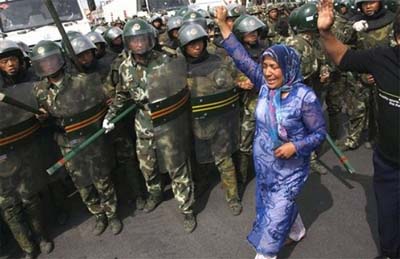
Authorities in Khotan have been continuing their closures of unlicensed religious schools. However, with 12children hurt in a raid this is unlikely to reduce the demand for such schools. UHRP report that police are undergoing extensive searches of all neighbourhoods with the right to use force where they deem fit. As is often in the case in Xinjiang, security measures will probably likely lead to greater insecurity as locals feel targeted and discontent grows. On this front, the biggest story doing the rounds of the blogosphere at the moment is the case of the Hotan Prefecture Jinxing Trading Company, which banned the sale of clothing with “religious characteristics” from its property. This is allegedly under orders from the local government and will mean no leases for Uyghur businesswomen. It will also mean no entry to these markets if you wear clothes deemed to have “religious characteristics”. These restrictions apply to the veil as well as the jilbab, which leaves the face entirely open (pictured above). It is unlikely that Uyghurs will accept this has any “security” benefits as it continues to arbitrarily mark out Uyghurs and in this case Uyghur woman as “dangerous”.